Showing posts sorted by relevance for query coronavirus. Sort by date Show all posts

Thursday, January 30, 2020

Tracking Coronavirus 2019 nCoV In Real-time


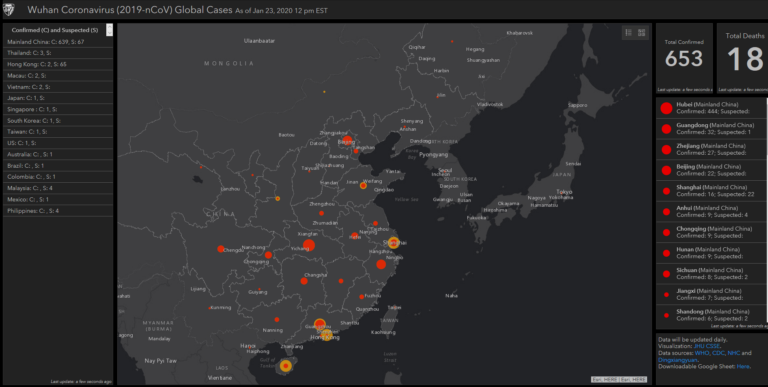
A new map from John Hopkins University now tracks the Wuhan Coronavirus in near real-time allowing concerned agencies and the public to see where the virus is expanding, tracking deaths occurring world-wide.

The World Health Organization was informed of a pneumonia of unknown cause from Wuhan City, China on December 31, 2019. On January 10 gene sequencing found it was a new and novel coronavirus and named 2019-nCoV. It is related to the Middle Eastern Respiratory Syndrome and Severe Acute Respiratory Syndrome. 

At this time the mortality and transmissibility is unknown but seems to be transmissable before symptoms appear which may be between a few days and 14 days.  It appears that about 1 in 50 affected die from the disease. These number may change as the coronavirus is understood more and better statistics become available from China and around the world.

On Thursday coronavirus has been declared a global emergency by the World Health Organization, as the outbreak continues to spread outside China.

"The main reason for this declaration is not what is happening in China but what is happening in other countries," said WHO chief Tedros Adhanom Ghebreyesus.

John Hopkins University's Center for Systems Science and Engineering developed an online dashboard mapping system to track reported cases from WHO, CDS, ECDC, China CCDC, NHC and DXY a Chinese website that aggregates NHC and local CCDC situation reports in near real-time.

John Hopkins Map:
https://gisanddata.maps.arcgis.com/apps/opsdashboard/index.html#/bda7594740fd40299423467b48e9ecf6

Thursday, April 30, 2020

Things To Do At Home

Things you can do at home to support mental and emotional health:
• 32 National Parks you can explore from your couch, from the Grand Canyon to Yellowstone: (requires google earth)
o Article: https://www.insider.com/national-parks-america-virtual-tours-3d-visit-2020-3

• New York Public Library is offering more than 300,000 e-books and audiobooks available for free:
o Source: https://www.nypl.org/books-music-movies/ebookcentral

• Museums are offering free virtual tours:
o Article: https://www.travelandleisure.com/attractions/museums-galleries/museums-with-virtual-tours

o Article: https://news.artnet.com/art-world/art-institute-chicago-offers-open-access-44000-images-1377739

Additional Resources
• Metropolitan Opera: Nightly Met Opera Streams: https://www.metopera.org/

oArticle explaining the program: https://www.metopera.org/about/press-releases/met-to-launch-nightly-met-opera-streams-a-free-series-of-encore-live-in-hd-presentations-streamed-on-the-company-website-during-the-coronavirus-closure/

• Zoos are bringing their animals online during COVID-19 closures:

o Article

https://www.inquirer.com/health/coronavirus/coronavirus-covid19-zoos-closed-philadelphia-elmwood-park-cape-may-animals-20200319.html

• NPR: NPR is compiling a list of live virtual concerts to watch.
o Article:

https://www.npr.org/2020/03/17/816504058/a-list-of-live-virtual-concerts-to-watch-during-the-coronavirus-shutdown

• NASA: NASA has put their entire collection of images, sounds, and videos of galaxies, planets, and space missions online, publicly accessible and copyright free for anyone to view or use.
o Source: https://www.nasa.gov/

3 Articles:
Reviewing the Effectiveness of Music Interventions in Treating Depression: https://www.ncbi.nlm.nih.gov/pmc/articles/PMC5500733/

• “In particular, elderly participants showed impressive improvements when they listened to music or participated in music therapy projects.”
• “Dementia patients showed significant cognitive and emotional benefits when they sang, or listened to familiar songs”

Friday, January 24, 2020

Center For Disease Control Issues Coronavirus Info

ATLANTA, GA. -- CDC is closely monitoring an outbreak of respiratory illness caused by a novel (new) coronavirus (termed “2019-nCoV”) that was first detected in Wuhan City, Hubei Province, China and which continues to expand. Chinese health officials have reported hundreds of infections with 2019-nCoV in China, including outside of Hubei Province. Infections with 2019-nCoV also are being reported in a growing number of countries internationally, including the United States, where the first 2019-nCoV infection was detected in a traveler returning from Wuhan on January 21, 2020.

Coronaviruses are a large family of viruses, some causing illness in people and others that circulate among animals, including camels, cats and bats. Rarely, animal coronaviruses can evolve and infect people and then spread between people such as has been seen with MERS and SARS.

When person-to-person spread has occurred with MERS and SARS, it is thought to have happened via respiratory droplets produced when an infected person coughs or sneezes, similar to how influenza and other respiratory pathogens spread. Spread of MERS and SARS between people has generally occurred between close contacts. Past MERS and SARS outbreaks have been complex, requiring comprehensive public health responses.

Early on, many of the patients in the outbreak in Wuhan, China reportedly had some link to a large seafood and animal market, suggesting animal-to-person spread. However, a growing number of patients reportedly have not had exposure to animal markets, suggesting person-to-person spread is occurring. At this time, it’s unclear how easily or sustainably this virus is spreading between people.

Both MERS and SARS have been known to cause severe illness in people. The situation with regard to 2019-nCoV is still unclear. While severe illness, including illness resulting in a number of deaths has been reported in China, other patients have had milder illness and been discharged.

There are ongoing investigations to learn more. This is a rapidly evolving situation and information will be updated as it becomes available.
On This Page
Situation Summary
Risk Assessment
What to Expect
CDC Response
Other Available Resources

Risk Assessment

Outbreaks of novel virus infections among people are always of public health concern. The risk from these outbreaks depends on characteristics of the virus, including whether and how well it spreads between people, the severity of resulting illness, and the medical or other measures available to control the impact of the virus (for example, vaccine or treatment medications).

Investigations are ongoing to learn more, but person-to-person spread of 2019-nCoV is occurring. It’s important to note that person-to-person spread can happen on a continuum. Some viruses are highly contagious (like measles), while other viruses are less so. It’s not clear yet how easily 2019-nCoV spreads from person-to-person. It’s important to know this in order to better assess the risk posed by this virus. While CDC considers this is a very serious public health threat, based on current information, the immediate health risk from 2019-nCoV to the general American public is considered low at this time. Nevertheless, CDC is taking proactive preparedness precautions.
What to Expect

More cases are likely to be identified in the coming days, including more cases in the United States. Given what has occurred previously with MERS and SARS, it’s likely that some person-to-person spread will continue to occur.

Meanwhile in China, the government is issuing continuing news and information on the spread and prevention on it's television outlet China Global Television Network with live English and other language broadcasts at https://america.cgtn.com/tv-schedule. The World Today news program airs weekdays at 2, 3, 5, 6:30 and 8PM and weekends at 2, 3, 4, 6 and 7PM and usually on the hour during the morning hours where Coronavirus updates are shown.

Monday, March 09, 2020

Breaking News - Coronavirus From Florida DOH

TALLAHASSEE --International Travel Advisory

The Florida Department of Health is advising all individuals who have traveled internationally to follow the new CDC guidelines, summarized below:

Level 3: Mandatory 14-day self-isolation and practice social distancing upon return to the United States. Social distancing includes avoiding going out in public and close personal interactions. If you become symptomatic, immediately self-isolate and contact your county health department or health care provider.
Level 2 and Cruises: Monitor your health and limit interactions with others for 14 days after returning to the United States. If you become symptomatic, immediately self-isolate and contact your county health department or health care provider.
For more information regarding current CDC travel advisories related to COVID-19, visit: https://www.cdc.gov/coronavirus/2019-ncov/travelers/index.html

Nile Cruise Advisory
The Florida Department of Health is advising all individuals who traveled on a river cruise on the Nile River in Egypt in February 2020 to self-isolate for 14 days following their date of return to the United States. Several passengers in the United States recently developed symptoms and have been confirmed to be infected with coronavirus disease 2019 (COVID-19), including two positive cases in Florida.

COVID-19 Testing Results

18 Florida cases (17 Florida residents)
12 diagnosed in Florida
5 diagnosed and isolated in another state
1 confirmed positive non-Florida resident isolated in Florida.

· 115 tests in state results pending

· 140 negatives

· 1,104 people monitored to date

· 302 of 1,104 are currently being monitored

People who have tested positive for COVID-19 will remain in isolation until they test negative.

Please visit the Department’s dedicated COVID-19 webpage for information and guidance regarding COVID-19 in Florida.

For any other questions related to COVID-19 in Florida, please contact the Department’s dedicated COVID-19 Call Center by calling 1-(866) 779-6121. The Call Center is available 24 hours a day. Inquiries may also be emailed to COVID-19@flhealth.gov.
With confirmed cases of Coronavirus Disease 2019 (COVID-19) in Florida, the Florida Department of Health is urging everyone to stay informed on how to protect themselves and their communities from COVID-19. The Department of Health’s (DOH) dedicated COVID-19 webpage at www.FloridaHealth.gov/COVID-19 remains the best and most up-to-date resource for information and guidance regarding COVID-19 in Florida.
Preventative actions include:
Washing your hands frequently with soap and water for at least 20 seconds, especially after going to the bathroom, before eating, and after blowing your nose, coughing or sneezing. If soap and water are not available, use an alcohol-based hand sanitizer with at least 60% alcohol.
Avoiding close contact with people who are sick.
Avoid touching your eyes, nose, and mouth.
Staying home when you are sick.
Clean and disinfect frequently touched objects and surfaces using a regular household cleaning spray or wipe.
Before traveling take certain steps:
Check the CDC’s Traveler’s Health Notices for the latest guidance and recommendations for each country to which you will travel.

How is COVID-19 diagnosed and treated? There is currently no vaccine to prevent COVID-19. Please call ahead to a healthcare professional if you believe you have been exposed and show symptoms of a fever, cough or difficulty breathing. Your healthcare professional will work with the health department to determine if you need to be tested for COVID-19.

Wednesday, March 25, 2020

Drive-Thru Coronavirus Testing In Clewiston

WEST PALM BEACH, FL- In the midst of the current COVID-19 (Coronavirus) pandemic, Florida Community Health Centers, Inc. (FCHC) continues to provide high quality and affordable routine healthcare to our community in a safe environment while working to decrease the further spread of this newly prevalent disease.

In an effort to support our patients and community, starting Tuesday, March 24, FCHC will begin Drive Thru testing for COVID-19 by appointment only. Those with the associated risk factors and symptoms of COVID-19 may be screened and evaluated by FCHC staff for testing.

Coronavirus symptoms include: fever, cough, and shortness of breath Risk factors consist of ONE or MORE of the following:

 Close contact with a laboratory-confirmed COVID-19 case
 Travel to or from a Coronavirus affected area
 Recent history of international travel or cruise
 Age 65+ with chronic conditions
 Weakened immune system

If anyone is experiencing the symptoms outlined above and has risk factors for COVID 19, they are encouraged to call one of the FCHC locations below to setup an appointment for screening, evaluation, and testing. Telehealth appointments are also available.

The FCHC Centers Drive Thru testing will be at the following locations:
Fort Pierce Center (beginning March 24)
Address: 1505 Delaware Avenue, Fort Pierce, FL 34950 | Phone: (772) 461-1402

Clewiston Center (beginning March 25)
Address: 315 South W.C. Owen Avenue, Clewiston, FL 33440 | Phone: (863) 983-7813

Indiantown Center (beginning March 26)
Address: 15858 S.W. Warfield Blvd., Indiantown, FL 34956 | Phone: (772) 597-3596

Dr. Fred Brown Children’s Health Center (beginning March 30)
Address: 2015 US-441 Okeechobee, USA FL 34972 | Phone: (863) 763-1951

Port St. Lucie Children’s Health Center (beginning March 31)
Address: 1701 S.E. Hillmoor Drive, Suite 19, Port St. Lucie, FL 34952 | Phone: (772) 335-8455

Saturday testing will be available at some sites.

Monday, March 02, 2020

Coronavirus Hits Florida - Governor Declares Emergency

TALLAHASSEE— The Florida Department of Health (Department) has announced there are two presumptive positive cases of 2019 coronavirus disease (COVID-19) in Florida. Both individuals remain in isolation at this time. Despite these cases in Florida, the overall immediate threat to the public remains low.

Florida Governor Ron DeSantis issued an order on Sunday directing a public health emergency in the state after it recorded its first two positive cases of the new coronavirus (COVID-19).

The first patient is an adult Manatee county resident without travel history to countries identified for restricted travel by the CDC. This person did seek health care, is isolated and will continue to remain isolated until cleared by public health officials. The Florida Department of Health is working closely with the patient, their close contacts and health care providers to isolate and monitor persons who may have been exposed to COVID-19 and implement testing of anyone who may develop COVID-19 symptoms, including fever, cough, or shortness of breath.

The second patient is an adult resident of Hillsborough county with a history of travel to Italy. This person is isolated and will continue to remain isolated until cleared by public health officials.

Governor Ron DeSantis said, "I have been working with federal partners and our Department of Health to ensure that communities are ready to handle the challenges presented by COVID-19. The dedicated professionals at our county health departments, as well as those working at local medical providers, are well equipped to address these and future cases. State Surgeon General Dr. Scott Rivkees has taken appropriate, decisive action to help affect the best possible outcomes, and I will continue directing our state agencies to do whatever is necessary to prioritize the health and well-being of Florida residents.”

Lieutenant Governor Jeanette Nuñez said,"Florida is a national leader in public health, and that quickly became evident as soon as we received information regarding presumptive positive cases of COVID-19 in our state. Public health teams from our Department of Health have already begun engaging with the impacted individuals and are quickly working towards identifying and contacting everyone who may be potentially affected by this virus. Thanks to the extensive preparations and tireless work the Department's staff has been undertaking since information regarding COVID-19 became available in early January, our county health departments, medical providers and all other partners in public health are well prepared to prevent the spread of COVID-19.”

State Surgeon General Dr. Scott Rivkees said,"This is the scenario that we prepare for every day in public health. The Department is moving forward with the appropriate plans, and we are working directly with the Centers for Disease Control and Prevention (CDC) and local medical providers to ensure these individuals receive the proper treatment and that anyone who has come into contact with them is following the necessary protocols, limiting or stopping any further spread. Thanks to Florida's integrated public health system, we have been able to proactively engage and plan with our public health partners at every level, enabling us to take these important steps in a very expeditious manner. Our epidemiological teams are among the best in the nation, and they are right now aggressively pursuing every potential lead during these critical early moments of this outbreak in Florida.”

COVID-19 can spread from person to person through small droplets from the nose or mouth, including when an individual coughs or sneezes. These droplets may land on objects and surfaces. Other people may contract COVID-19 by touching these objects or surfaces, then touching their eyes, nose or mouth.

Symptoms of COVID-19 are fever, cough and shortness of breath. Symptoms may appear in as few as two days or as many as 14 days following exposure. Most people recover from the COVID-19 without needing special treatment. The elderly and those with underlying medical problems like high blood pressure, heart problems and diabetes, are more likely to develop serious illness.

There is currently no vaccine to prevent COVID-19. The best way to prevent illness is to avoid being exposed to this virus. As a reminder, the Department always recommends everyday preventive actions to help impede the spread of respiratory diseases, including:
Avoiding close contact with people who are sick;
Staying home when you are sick and avoiding contact with persons in poor health;
Avoiding touching your eyes, nose and mouth with unwashed hands;
Covering your cough or sneeze with a tissue, then disposing of the tissue;
Washing your hands often with soap and water for at least 20 seconds, especially after going to the bathroom, before eating, after blowing your nose, coughing or sneezing;

- If soap and water are not readily available, use an alcohol-based hand sanitizer with at least 60% alcohol. Always wash hands with soap and water if hands are visibly dirty; and
Cleaning and disinfecting frequently touched objects and surfaces using a regular household cleaning spray or wipe.

The CDC does not recommend that asymptomatic, healthy people wear a facemask to protect themselves from respiratory diseases, including COVID-19. Facemasks should be used by people who show symptoms of COVID-19 to help prevent the spread of the disease to others. The use of facemasks is also crucial for health workers and people who are taking care of someone in close settings (at home or in a health care facility).

A person that experiences a fever and symptoms of respiratory illness, such as fever, cough or shortness of breath, within 14 days after travel from China, Italy, Iran, South Korea, Japan and any other destination under CDC travel advisory should call ahead to their health care provider and local county health department (CHD) and mention their recent travel or close contact.

If a person has had close contact with someone showing these symptoms who has recently traveled from this area or been in contact with a person with laboratory-confirmed COVID-19, they should call ahead to a health care professional and the county health department. The health care professional will work with the Department to determine if the person should be tested for COVID-19.

Please visit the Department's dedicated COVID-19 webpage atwww.FloridaHealth.gov/COVID-19. This remains the best and most up-to-date resource for information and guidance regarding COVID-19 in Florida.

For any other questions related to COVID-19 in Florida, please contact the Department's dedicated COVID-19 Call Center by calling1-866-779-6121 or emailing COVID-19@flhealth.gov. The Call Center is available Monday through Friday, 8:00am to 5:00pm.

In addition, please visithttp://www.floridahealth.gov/all-county-locations.html to locate and obtain contact information for your local CHD.

The CDC also has a website with information related to COVID-19:https://www.cdc.gov/coronavirus/2019-ncov/index.html.

Saturday, March 28, 2020

39-Year Old Hendry Female Positive For Coronavirus

First Patient Tests Positive COVID-19 In Hendry County
UPDATE: March 30, 2020 at 12 noon - There are now 3 positive cases in Hendry, two women and one 28 year old male in Clewiston, and 3 positive cases in Glades county. Okeechobee county has 0 positive cases out of 47 tested.

UPDATE: March 29, 2020 at 7 p.m. - The latest case is confirmed to be a 70 year old female resident of Clewiston. The case confirmed on Saturday is a 39 year old female also a resident of Clewiston. 47 people have been tested.

In Glades county a 56 year old male has tested positive. Four others were tested negative.

Okeechobee county still has no cases out of 45 tested.

LABELLE, FL. March 28 -- A 39-year old female in Hendry County, Fl. has tested positive for COVID-19 today, the first in Hendry county.

The Florida Department of Health reported this evening that 38 persons have been tested for the coronavirus so far in Hendry county, all negative except 1 female.

In Glades county, on the northern border of Hendry, four persons have tested negative. In Okeechobee county 42 persons have tested negative.

Broward county on the southeast border of Hendry county has tested 2,941 total, with 6,989 negative, 801 positive. Palm Beach county has 1,540 negative and 306 positive cases.

Florida has competed 43,071 tests so far with 4,038 positive and 37,327 negative. There have been 56 deaths in Florida.

New York City - Epicenter Of Coronavirus

In comparison to Florida testing, New York state has completed more than any other state by far, giving a better view of where the most cases are located with better ability to quarantine those, and those whom they've been in contact with, and to prepare hospitals with equipment and personnel where needed.

As of Saturday, March 28, NYC has more than 29,766 cases with 1 in 286 people in NYC being tested positive with the virus. Italy has 1 in 655 people infected. New York City is now the epicenter in the world with more per capita cases than Italy, Spain, Switzerland and China and every other country in the world.

Friday, February 28, 2020

What You Need To Know About Coronavirus Prevention


The Center For Disease Control in Atlanta advises the public in the U.S. to take preventative action to prevent the spread of diseases.


There is currently no vaccine to prevent coronavirus disease 2019 (COVID-19). The best way to prevent illness is to avoid being exposed to this virus. However, as a reminder, CDC always recommends everyday preventive actions to help prevent the spread of respiratory diseases, including:

Avoid close contact with people who are sick.
Avoid touching your eyes, nose, and mouth.
Stay home when you are sick.
Cover your cough or sneeze with a tissue, then throw the tissue in the trash.
Clean and disinfect frequently touched objects and surfaces using a regular household cleaning spray or wipe.
Follow CDC’s recommendations for using a facemask.
CDC does not recommend that people who are well wear a facemask to protect themselves from respiratory diseases, including COVID-19.
Facemasks should be used by people who show symptoms of COVID-19 to help prevent the spread of the disease to others. The use of facemasks is also crucial for health workers and people who are taking care of someone in close settings (at home or in a health care facility).
Wash your hands often with soap and water for at least 20 seconds, especially after going to the bathroom; before eating; and after blowing your nose, coughing, or sneezing.
If soap and water are not readily available, use an alcohol-based hand sanitizer with at least 60% alcohol. Always wash hands with soap and water if hands are visibly dirty.

For information about handwashing, see CDC’s Handwashing website

For information specific to healthcare, see CDC’s Hand Hygiene in Healthcare Settings

These are everyday habits that can help prevent the spread of several viruses. CDC does have specific guidance for travelers.

Thursday, June 18, 2020

Face Masks? The Controversy On Wearing Masks

LABELLE, FL. --  The wearing of face masks to prevent the spread of COVID-19 has in recent weeks, been the subject of controversy as governmental entities, commentators, and news reports give conflicting views on the subject.

While all agree that physical distancing is the very best prevention, mask wearing has yet to be resolved.

Some experts say there are yet no reliable studies on the effectiveness of wearing cloth masks to prevent coronavirus spread.

Factors cited are that coronavirus particles are able to move easily through cloth masks either along the sides or top of the loose fitting masks as one breathes in and out, or through the fabric itself, because particle are small enough to easily pass through. The virus may also be able to enter the eyes, which are not at all protected by cloth masks.

Proponents of wearing cloth masks say that it can't hurt to wear masks, and seems reasonable to do so in public, with a benefit of allowing more social gatherings, and continuation of business openings if everyone wears masks. Governments and politicians in growing numbers seem ready to promote mask wearing in order to rationalize the opening of businesses, sports events, and mass gatherings.

While the CDC and WHO give recommendations for certain situations, any  recommendation to make it a requirement to wear them has not been given.

Links to sources about wearing face masks, their reliability, recommendations and requirements around the world, and more:

https://www.google.com/search?q=wiki+coronavirus+and+masks&rlz - overall discussions and expert advice
https://www.cidrap.umn.edu/covid-19/podcasts-webinars/special-ep-masks - expert's discussion and podcast on lack of evidence for wearing masks to prevent COVID spread

Wednesday, March 11, 2020

Glades Jail False Report On Coronavirus Threat

MOORE HAVEN, FL. -- Glades County Sheriff's Office's spokesperson Keith Henson is reporting that an inaccurate news story was published by the Miami News Times yesterday, indicating that jail operations at the Glades County Sheriff’s Office have been compromised by the Coronavirus. 

The report that the facility has enacted quarantine procedures for coronavirus testing is false. There is no suspicion, indication or evidence of the COVID-19 virus at the facility.

"The Sheriff’s Office is working closely with local, state and federal offices and officials, as we, as a community and nation make appropriate preparations and take protective measures during this time of concern, related community safety," said Henson.

Monday, March 02, 2020

UPDATE- Two COVID-19 Cases Found In Florida's Gulfcoast

TALLAHASSEE— The Florida Department of Health has announced there are two presumptive positive cases of 2019 coronavirus disease (COVID-19) in Florida. Both individuals remain in isolation at this time. Despite these cases in Florida, the overall immediate threat to the public remains low.

The first patient is an adult Manatee county resident without travel history to countries identified for restricted travel by the CDC. This person did seek health care, is isolated and will continue to remain isolated until cleared by public health officials. The Florida Department of Health is working closely with the patient, their close contacts and health care providers to isolate and monitor persons who may have been exposed to COVID-19 and implement testing of anyone who may develop COVID-19 symptoms, including fever, cough, or shortness of breath.

The second patient is an adult resident of Hillsborough county with a history of travel to Italy. This person is isolated and will continue to remain isolated until cleared by public health officials.

COVID-19 can spread from person to person through small droplets from the nose or mouth, including when an individual coughs or sneezes. These droplets may land on objects and surfaces. Other people may contract COVID-19 by touching these objects or surfaces, then touching their eyes, nose or mouth.

Symptoms of COVID-19 are fever, cough and shortness of breath. Symptoms may appear in as few as two days or as many as 14 days following exposure. Most people recover from the COVID-19 without needing special treatment. The elderly and those with underlying medical problems like high blood pressure, heart problems and diabetes, are more likely to develop serious illness.

There is currently no vaccine to prevent COVID-19. The best way to prevent illness is to avoid being exposed to this virus.

- If soap and water are not readily available, use an alcohol-based hand sanitizer with at least 60% alcohol. Always wash hands with soap and water if hands are visibly dirty; and
Cleaning and disinfecting frequently touched objects and surfaces using a regular household cleaning spray or wipe.

The CDC does not recommend that asymptomatic, healthy people wear a facemask to protect themselves from respiratory diseases, including COVID-19. Facemasks should be used by people who show symptoms of COVID-19 to help prevent the spread of the disease to others. The use of facemasks is also crucial for health workers and people who are taking care of someone in close settings (at home or in a health care facility).

A person that experiences a fever and symptoms of respiratory illness, such as fever, cough or shortness of breath, within 14 days after travel from China, Italy, Iran, South Korea, Japan and any other destination under CDC travel advisory should call ahead to their health care provider and local county health department (CHD) and mention their recent travel or close contact.

If a person has had close contact with someone showing these symptoms who has recently traveled from this area or been in contact with a person with laboratory-confirmed COVID-19, they should call ahead to a health care professional and the county health department. The health care professional will work with the Department to determine if the person should be tested for COVID-19.

Other Southwest Florida Online Coronavirus stories: https://swflorida.blogspot.com/search?q=coronavirus

Saturday, March 07, 2020

Breaking News - Two Coronavirus Deaths In Florida

TALLAHASSEE— The Florida Department of Health has announced updates regarding the 2019 coronavirus disease (COVID-19) in Florida. Two individuals have died and two new presumptive positive cases have been identified in Broward County.

Deceased Individuals
A previously announced COVID-19 patient in Santa Rosa County has died, following an international trip.
A new individual in their seventies that tested presumptive positive for COVID-19 in Lee County has died, following an international trip.

New Presumptive Positive Cases
A 75-year old male in Broward County has been identified as a presumptive positive. This person is isolated and will continue to remain isolated until cleared by public health officials.
A 65-year old male in Broward County has been identified as a presumptive positive. This person is isolated and will continue to remain isolated until cleared by public health officials.

The Florida Department of Health is working closely with the patients, potential close contacts of each case and health care providers to isolate and monitor persons who may have been exposed to COVID-19 and implement testing of anyone who may develop COVID-19 symptoms, including fever, cough or shortness of breath.

COVID-19 can spread from person to person through small droplets from the nose or mouth, including when an individual coughs or sneezes. These droplets may land on objects and surfaces. Other people may contract COVID-19 by touching these objects or surfaces, then touching their eyes, nose or mouth.

Symptoms of COVID-19 are fever, cough and shortness of breath. Symptoms may appear in as few as two days or as many as 14 days following exposure. Most people recover from the COVID-19 without needing special treatment. The elderly and those with underlying medical problems like high blood pressure, heart problems and diabetes, are more likely to develop serious illness.

There is currently no vaccine to prevent COVID-19. The best way to prevent illness is to avoid being exposed to this virus. As a reminder, the Department always recommends everyday preventive actions to help impede the spread of respiratory diseases, including:

Avoiding close contact with people who are sick;
Staying home when you are sick and avoiding contact with persons in poor health;
Avoiding touching your eyes, nose and mouth with unwashed hands;
Covering your cough or sneeze with a tissue, then disposing of the tissue;
Washing your hands often with soap and water for at least 20 seconds, especially after going to the bathroom, before eating, after blowing your nose, coughing or sneezing;

- If soap and water are not readily available, use an alcohol-based hand sanitizer with at least 60% alcohol. Always wash hands with soap and water if hands are visibly dirty; and

Cleaning and disinfecting frequently touched objects and surfaces using a regular household cleaning spray or wipe.

The CDC does not recommend that asymptomatic, healthy people wear a facemask to protect themselves from respiratory diseases, including COVID-19. Facemasks should be used by people who show symptoms of COVID-19 to help prevent the spread of the disease to others. The use of facemasks is also crucial for health workers and people who are taking care of someone in close settings (at home or in a health care facility).

A person that experiences a fever and symptoms of respiratory illness, such as fever, cough or shortness of breath, within 14 days after travel from China, Italy, Iran, South Korea, Japan and any other destination under CDC travel advisory should call ahead to their health care provider and local county health department (CHD) and mention their recent travel or close contact.

If a person has had close contact with someone showing these symptoms who has recently traveled from this area or been in contact with a person with laboratory-confirmed COVID-19, they should call ahead to a health care professional and the county health department. The health care professional will work with the Department to determine if the person should be tested for COVID-19.

Please visit the Department's dedicated COVID-19 webpage at www.FloridaHealth.gov/COVID-19. This remains the best and most up-to-date resource for information and guidance regarding COVID-19 in Florida.

For any other questions related to COVID-19 in Florida, please contact the Department's dedicated COVID-19 Call Center by calling 1-866-779-6121 or emailing COVID-19@flhealth.gov. The Call Center is available 24 hours a day, seven days a week.

In addition, please visit http://www.floridahealth.gov/all-county-locations.html to locate and obtain contact information for your local CHD.

The CDC also has a website with information related to COVID-19: https://www.cdc.gov/coronavirus/2019-ncov/index.html.
Wednesday, March 18, 2020

How Taiwan Escaped Coronavirus - Can We Do It Here?

What Works To Slow The Spread Of Coronavirus

Taiwan, China has managed the COVID-19 crisis with an expertise that has prevented large scale infections in the country of 23 million, despite the country's location 85 miles from mainland China. 

As of today March 20, 2020 there are only 100 confirmed cases in Taiwan, or one person in 230,000 and only 1 death with 22 recovered as of today. By comparison the Netherlands (one of only a dozen or so countries with adequate testing), with a population of 17,200,000 has 1,710 cases or 1 per 10,000 persons with 43 deaths and only 2 recovered.

(Among the countries with presumed adequate early testing and universal healthcare to varying degrees is China, Iran, South Korea, Germany, France, Spain, Italy, Netherlands, Belgium, Norway, Sweden, Switzerland, and Denmark. Universal testing allows health authorities to better pinpoint where the hot spots are to allow better plans for mitigation.)

The following has been taken from a paper published in the Journal of the American Medical Association March 3, 2020.

"The country has 23 million citizens of which 850 000 reside in and 404 000 work in China. In 2019, 2.71 million visitors from the mainland traveled to Taiwan.

"Taiwan leveraged its national health insurance database and integrated it with its immigration and customs database to begin the creation of big data for analytics; it generated real-time alerts during a clinical visit based on travel history and clinical symptoms to aid case identification. It also used new technology, including QR code scanning and online reporting of travel history and health symptoms to classify travelers’ infectious risks based on flight origin and travel history in the past 14 days.

"On January 20, the Taiwan CDC announced that the government had under its control a stockpile of 44 million surgical masks, 1.9 million N95 masks, and 1100 negative-pressure isolation rooms.

"Taiwan citizens’ household registration system and the foreigners’ entry card allowed the government to track individuals at high risk because of recent travel history in affected areas.

"A mobile health declaration pass was then sent via SMS to phones using a local telecom operator, which allowed for faster immigration clearance for those with minimal risk. This system was created within a 72-hour period. On February 18, the government announced that all hospitals, clinics, and pharmacies in Taiwan would have access to patients’ travel histories."

From Big Data Analytics, New Technology, and Proactive Testing by
C. Jason Wang, MD, PhD1,2; Chun Y. Ng, MBA, MPH2; Robert H. Brook, MD, ScD3,4
Article Information
Published online March 3, 2020. Journal of the American Medical Association JAMA
Full Article:https://jamanetwork.com/journals/jama/fullarticle/2762689

Wednesday, March 11, 2020

UPDATE: CDC Coronavirus Teleconference Audio


ATLANTA, GA. -- The Centers for Disease Control and Prevention (CDC) provides an audio teleconference update to media on the COVID-19 response by Nancy Messonnier, M.D., Director, National Center for Immunization and Respiratory Diseases.

As of Thursday morning (EST) there were 121,564 confirmed cases reported, 67% were in mainland China where the daily rate of increase has diminished to nearly zero, and 1,050 cases in the U.S. 7,750. Increasing amounts of case are reported in South Korea with 7,555, and 10,149 in Italy, and 581 in Japan. The numbers are expected to jump greatly when the U.S. and other countries and U.S. states achieve higher number of testing. 

See https://swflorida.blogspot.com/2020/03/fear-whats-missing-in-us-coronavirus.html about lack of testing throughout the world especially in the U.S.

Quarantined areas include now the entire country of Italy where travel restriction are limited to going to work and emergencies and all travelers are required to carry paperwork indicating why they are traveling. Westchester county, New York is limiting travel and not allowing assemblies of large crowds, including closing schools and churches in a 3 square mile section.

The CDC may be considering specific advice for area of high infections for Washington, New York, Florida and California this week.

Click for the latest teleconference audio update from the CDC this week:
https://www.cdc.gov/media/releases/2020/t0309-covid-19-update.mp3

Friday, May 14, 2021

How Safe Are We From New COVID Outbreaks? Opinion

OPINION by the editor, Southwest Florida Online 

As CDC guidance changes, yesterday announcing mask wearing and social distancing is a personal choice and not necessary for those fully vaccinated, one might still wonder just how safe we are and can we really predict the future of COVID outbreaks very well.

As, of yesterday, the United States has the third most daily COVID infections after India and Brazil. The US had 39,825 new cases yesterday and has the most total cases of all nations at 36.3 million. https://www.worldometers.info/coronavirus/#countries

Florida had the most new infections yesterday of all the 50 states. With 4,064, it is almost double that of Texas, Pennsylvania, and New York, the other front runners for new infections in the U.S. https://www.worldometers.info/coronavirus/country/us/ 

Some Island nations are showing large increases in infections, for example the Seychelles Island off of Africa, despite two-thirds of the 100,000 population being already vaccinated, the highest percentage of the population vaccinated in the word. One-third of the new infections are of those already vaccinated. https://www.bloomberg.com/news/articles/2021-05-10/world-s-most-vaccinated-nation-says-active-covid-cases-surge

The Seychelles have 9,288 cases per 100,000 population, the US has 10,159 per 100,000 and Florida 10,627 cases per 100,000.

It may be our ability to predict an unpredictable virus is not all that great or rational to believe we can.

UPDATE: Taiwan, one of the safest places in the world, with the least deaths and COVID infections over the last year, is now imposing new restrictions to prevent outbreaks. With 24 million population only 1,845 cases and 12 death were reported. New cases surged by more than three times to 344 this week from only 100 the previous week.

https://news.yahoo.com/success-story-taiwan-faces-worst-081121067.html

Video: Mask Confusion Rises; Late Show with Stephen Colbert/Youtube

Monday, March 16, 2020

Glades County Schools Suspend Operations

Glades County School District Suspends Operations in Response to Coronavirus
All staff will report to work on Monday, March 23, 2020.

MOORE HAVEN, FL. (March 16, 2020) - The Commissioner of the Florida Department of Education has directed all public schools in Florida to be closed for two weeks inclusive of their Spring Break. In adherence to this state mandate, Glades County School District will be CLOSED to all students Monday, March 16th through Friday, March 27th. GCSD students and staff are on Spring Break this week, therefore the second week of closure will be next week.

FSA testing will be delayed by at least two weeks. All field trips, sporting events and extra-curricular activities including YMCA, are cancelled during the closure.

During the school closure custodial staff will be completing further deep cleaning of school sites. All staff will return to work on Monday, March 23rd to begin preparations should the schools stay closed longer than expected. Further information for staff will be sent in a separate communication.

District personnel will continue to monitor this rapidly changing situation and will follow Florida Department of Education directive. The District is thankful to GCSD family for their patience and flexibility with the ever-changing situation related to COVID-19 (Coronavirus).

“While there are so many unknowns, it is not going to stop us from doing what is best for our students, staff and community.” Kim Jordan, Glades County Superintendent of Schools adds “Our desire is to be sensitive to the emotional well-being of our students while keeping them safe during these complicated times.”

Future updates will be made via social media, phone call-outs, and website postings.

Thursday, October 01, 2020

SNAP Households To Receive 5% Increase In Food Supplement Benefits

More Help For Access To Nutritious Food Starts Today

The previously announced 5.3% cost of living increase to the maximum benefit amounts for the Supplemental Nutrition Assistance Program (SNAP) takes effect today, the U.S. Department of Agriculture (USDA) reminded. As a result, SNAP households will likely see an increase in their benefits starting this month.

Photo: Hendry County Deputies help direct traffic and Hendry jail inmates distribute free food boxes under the "Farmers To Families Food Boxes" program in North LaBelle today. Photo courtesy Barbara Whelan

Nearly all states have opted to automatically provide all SNAP households the maximum benefit for their household size under legislation passed in response to the pandemic. Therefore, with the increased maximum benefit amounts, a typical household of four will receive $680 a month, up from their previous amount of $646 per month, in addition to any benefits they receive from other nutrition assistance programs.

“The higher maximum monthly benefits will help ensure SNAP participants continue to have access to nutritious food during these unprecedented times,” said USDA’s Food and Nutrition Service Administrator Pam Miller. “These individuals and families are also eligible for other FNS programs that are helping to meet an increased need.”

The Food and Nutrition Act of 2008 mandates that maximum SNAP benefit allotments for each fiscal year (October through September) be adjusted to reflect the average cost of the Thrifty Food Plan in the proceeding June. The June 2020 Cost of Food Report revealed a 5.3% increase in the cost of the Thrifty Food Plan from last year, which is more than double the 20-year annual average increase of 2%, accounting for the rise in food costs.

The FY 2021 maximum SNAP allotments for the District of Columbia and all states other than Alaska and Hawaii are as follows:
Household Size Maximum Monthly Allotment
1 $204
2 $374
3 $535
4 $680
5 $807
6 $969
7 $1,071
8 $1,224
Each additional person $153

Maximum SNAP allotments are different for Alaska, Guam, Hawaii, and the U.S. Virgin Islands; those amounts can be found here.

Currently, as authorized by the Families First Coronavirus Response Act, nearly all states are also providing SNAP households with emergency allotments in response to the COVID-19 pandemic. These supplements bring benefit amounts for all SNAP households up to the maximum allotment for their household size, which will be higher beginning today.

SNAP households are also eligible for other USDA programs to help fulfill their nutrition needs. For example, SNAP participants may be able to receive:

Free school meals – Thanks to flexibilities provided by USDA, schools and other sites are currently able to provide meals at no cost to all children through FNS’ summer meal programs. Families can find meals at more than 87,000 locations across the country using FNS’ “Meals 4 Kids” interactive site finder.
WIC benefits – The Special Supplemental Nutrition Program for Women, Infants, and Children (WIC) provides food, health care referrals, and nutrition education to low-income pregnant and postpartum women, infants, and children up to age five who are at nutritional risk.
Pandemic EBT – A new benefit, authorized in the Families First Coronavirus Response Act, provides families of children who normally receive free or reduced-price meals at school with food-buying benefits similar to SNAP. In an average month, it provides an additional $114 per month, per child.
CSFP food boxes – The Commodity Supplemental Food Program provides boxes of nutritious, USDA-purchased foods to low-income seniors. ·
Support from food banks – Food banks often serve as the first line of defense against food insecurity for those in immediate need. USDA provides food and administrative funds to states, who in turn provide support to distributing agencies like food banks, through The Emergency Food Assistance Program (TEFAP). USDA has provided significant support to food banks throughout the pandemic.

The Farmers To Families Food Box Program has come under some criticism, the latest being a required letter from President Trump be included in each box. (See https://www.politico.com/news/2020/10/01/trump-letter-food-aid-boxes-424230)

USDA’s Food and Nutrition Service administers 15 nutrition assistance programs that leverage American’s agricultural abundance to ensure children and low-income individuals and families have nutritious food to eat. FNS also co-develops the Dietary Guidelines for Americans, which provide science-based nutrition recommendations and serve as the cornerstone of federal nutrition policy. Follow us on Twitter at @USDANutrition.

Tuesday, March 24, 2020

18 Patients Tested For COVID-19 In Hendry County

Only 18 Patients Tested For COVID-19 In Hendry County - 1 In Glades County

LABELLE, FL. -- The Florida Department of Health reported this morning that only 18 persons have been tested for the coronavirus so far in Hendry county. Reported were results for 11 men and 7 women aged 21 to 85 with average age of 47.

In Glades county, on the northern border of Hendry, one man age 69 has been tested negative.

UPDATE: As of 11 a.m. Wednesday March 25, Hendry county has 19 total tests, 17 negative and 2 pending. Glades county has 2 total tested, 1 male, 1 female, both negative.

Broward county on the southeast border of Hendry county tested 2,941 total, with 2,375 negative, 355 positive, 211 pending and 3 deaths.

Florida has competed 18, 289 tests so far with 1,682 positive and 15,374 negative with 1,233 pending. There have been 22 deaths in Florida.

UPDATE: As of 6 p.m. Wednesday March 25, Hendry has 20 total tests, 18 negative and 2 pending.

New York City - New Epicenter Of Coronavirus

In comparison to Florida testing, New York state has completed more than any other state by far, giving a better view of where the most cases are located with better ability to quarantine those, and those whom they've been in contact with, and to prepare hospitals with equipment and personnel where needed.

As of Wednesday, March 25, NYC has more than 17,856 cases with 1 in 476 people in NYC being tested positive with the virus. Italy has 1 in 875 people infected. New York City is now the epicenter in the world with more per capita cases than Italy, Spain, Switzerland and China and every other country in the world. 

Friday, April 10, 2020

15th Coronavirus Case In Hendry County Today

CLEWISTON, FL. -- As of 6 p.m. Friday, April 10, 2020, a 15th case of COVID-19 has been announced in Hendry county now affecting 8 men and 7 women, median age 40. Five have been hospitalized.

The latest two confirmed cases are a 43 year old male and a 72 year old female; both individuals are residents of Clewiston.

11 of the individuals who have tested positive in Hendry County are currently under isolation. 4 individuals have recovered and been cleared by the Florida Department of Health and are no longer required to be under isolation.

------------

UPDATE: As of 11 a.m. Saturday, April 11, a 16th case has been reported, a 46 year old female in Clewiston. 194 people have been tested so far.  1 in 2,572 people in Hendry have been found positive for the virus. (1 in 90 have tested positive for the virus in New York City for comparison)

UPDATE: As of 11 a.m. Sunday, April 12, a 17th case has been reported in Hendry county. 202 people have been tested. 1 in 2,420 people in Hendry have been found positive for the virus.

UPDATE: As of 6 p.m. Sunday, April 12, a 20th case has been reported in Hendry. 10 males and 10 females have tested positive so far, median age 44, in 205 persons tested.  1 in 2,057 people in Hendry have been found positive for the virus. (1 in 86 people have tested positive in New York City by comparison and 1 in 662 in Broward County, Florida.

The latest confirmed cases are a 33 year old male resident of Clewiston, a 55 year old female resident of Clewiston, a 64 year old male resident of Clewiston and a 64 year old female resident of LaBelle.

16 of the individuals who have tested positive in Hendry County are currently under isolation. 4 individuals have recovered and been cleared by the Florida Department of Health and are no longer required to be under isolation.


UPDATE: As of 11 a.m. Monday, April 13 a 21st case has been reported in Hendry, and 5th case in Glades county.  And at 6 p.m. Monday, two additional cases of COVID-19 have been confirmed in Hendry County, bringing the total number of confirmed cases in Hendry County to 22. 1 in 1,870 people in Hendry have tested positive for the virus.

The latest confirmed cases are an 11 year old male and a 29 year old female; both are residents of Clewiston.

16 of the individuals who have tested positive in Hendry County are currently under isolation. 6 individuals have recovered and been cleared by the Florida Department of Health and are no longer required to be under isolation.


-------------

Only 176 tests have been given in the county so far. 1 in 2,743 people have or have had the virus in Hendry.

In Glades county only 23 tests have been given with 4 people testing positive, including 3 men and 1 woman, median age 74. Three have been hospitalized including one who died previously. 1 in 3,402 have the virus in Glades.

HOW TO MAKE A FACEMASK: https://www.cdc.gov/coronavirus/2019-ncov/prevent-getting-sick/diy-cloth-face-coverings.html

Friday, March 20, 2020

Coronavirus Scam Alert - White Lab Coat Impersonators


LABELLE, FL. -- RESIDENTS BE AWARE! The Hendry Sheriff's office says thet are receiving from Broward and Palm Beach Counties, reports of people dressing in white lab coats wearing masks and gloves knocking on resident’s doors, identifying themselves as representatives from the Department of Health or the CDC and want to test residents for the COVID-19 (Corona) virus. At the time of this post, these reports are stemming from the east coast.

PLEASE KNOW: REPRESENTATIVES FROM THE CDC OR DEPARTMENT OF HEALTH WILL NOT SHOW UP AT YOUR RESIDENCE UNANNOUNCED!!! The CDC is not going door-to-door. Scammers are taking advantage of the coronavirus crisis and are trying to dupe consumers.

If anyone comes to your home unannounced wearing a white lab coat, mask and gloves do not open your DOOR and allow them entrance to your home. Once inside they are robbing individuals and are sometimes entering by force.

We cannot stress enough, that if someone comes to your home dressed in a white lab coat, mask and gloves representing the CDC or Department of Health, DO NOT OPEN YOUR DOOR! Instead call the Sheriff’s Office at 863-674-5600 or your nearest law enforcement.

If you have elderly family members please take a few minutes to make them aware of this.